
A wound that closes is an important milestone—but it does not always mean the underlying problem has been solved.
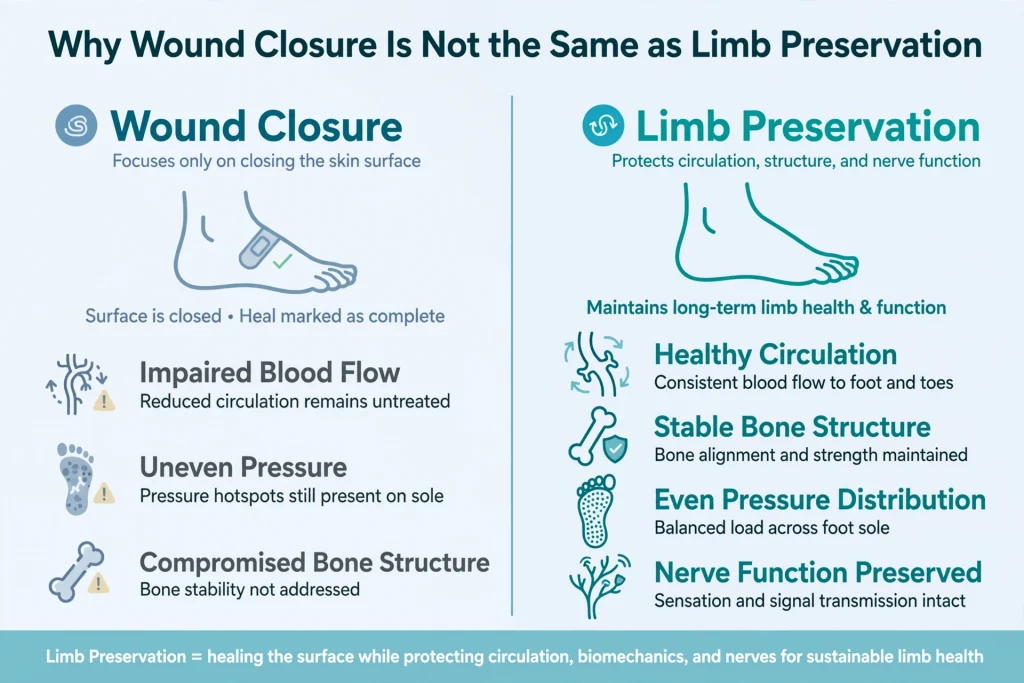
Wound closure signifies that the skin has healed, but it is distinct from limb preservation, which focuses on maintaining a stable, functional, and durable foot capable of supporting mobility and reducing future breakdown. At Seattle Foot and Ankle Center, Dr. J. John Hoy emphasizes that a wound may close while critical underlying problems, such as abnormal pressure, neuropathy, or circulatory limitations, persist. True limb preservation requires addressing these root causes to prevent recurrence and ensure the foot remains healed and functional long-term.
For patients with diabetic foot wounds, neuropathy, circulation problems, or complex foot deformities, closing the skin is only one part of the larger goal: preserving a functional limb.
Limb preservation requires looking beyond the wound itself. It involves understanding why the wound developed, whether the foot can withstand normal activity again, and what steps are needed to prevent recurrence or further tissue loss.
At Seattle Foot and Ankle Center, Dr. J. John Hoy approaches complex foot wounds with a focus on long-term function, not just short-term closure.
The Difference Between Wound Closure and Limb Preservation
Wound closure means that the skin has healed.
Limb preservation means the patient has maintained a stable, functional, and durable foot that can support mobility and reduce the risk of future breakdown.
These goals overlap, but they are not identical.
A wound may close while important problems remain:
- Abnormal pressure continues beneath the foot
- A deformity continues to create stress on the skin
- Neuropathy prevents the patient from recognizing new injury
- Bone or joint problems continue to affect stability
- Circulatory limitations increase the risk of future wounds
A healed wound can reopen if the factors that caused it were never addressed.
Why Some Foot Wounds Keep Returning
Many diabetic and high-risk foot wounds are not random injuries. They are often the result of a combination of factors working together.
Loss of Protective Sensation
Peripheral neuropathy can reduce or eliminate the ability to feel pressure, friction, heat, or injury.
A patient may continue walking on an area that is being damaged because the normal warning signals are absent.
Abnormal Foot Mechanics
The foot is designed to distribute pressure during walking. However, deformities or structural changes can create areas of excessive stress.
Examples include:
- Prominent bone areas
- Hammertoes
- Charcot-related deformity
- Contractures
- Changes following previous amputations
Even after a wound heals, these mechanical forces may remain.
Circulation Problems
Adequate blood flow is essential for healing and maintaining healthy tissue.
Patients with peripheral arterial disease may require evaluation of circulation before and during wound treatment. A wound that closes slowly—or repeatedly breaks down—may indicate that the tissue is struggling to tolerate normal demands.
The Problem With Treating Only the Wound
Treating only the wound is insufficient for limb preservation because a wound is often the visible result of a deeper, underlying problem. Simply covering the wound without addressing its root cause can be compared to repairing a warning light without investigating what triggered it. Successful limb preservation requires a coordinated approach that considers multiple factors, including pressure relief, foot structure, walking mechanics, infection control, bone involvement, circulation, and long-term prevention.
Simply covering the wound without addressing the cause can be compared to repairing a warning light without investigating what triggered it.
Successful limb preservation may require a coordinated approach that considers:
- Pressure relief
- Foot structure
- Walking mechanics
- Infection control
- Bone involvement
- Circulation
- Long-term prevention
The question is not only:
“Can we close this wound?”
The more important question is:
“Can we create a foot that stays healed?”
Limb Preservation Requires Looking at the Whole Foot
A comprehensive limb preservation evaluation considers the entire patient and the entire limb.
Important factors include:
Wound characteristics
- For limb preservation, key wound characteristics evaluated include the size and depth of the wound, its specific location on the foot, the duration it has been present, any signs of infection, and the overall tissue quality surrounding the wound.
Foot mechanics
- Foot mechanics are evaluated for limb preservation by assessing areas of excessive pressure, identifying any deformities, checking the overall stability of the foot, and determining its ability to accommodate appropriate footwear.
Overall health factors
- Diabetes control
- Neuropathy
- Circulation
- Activity level
- Ability to participate in preventive care
The goal is not simply to treat the current wound but to reduce the chance of future breakdown.
When Surgical Procedures May Be Part of Limb Preservation
Not every wound requires surgery. Many patients improve with appropriate wound care, pressure relief, footwear changes, and close monitoring.
However, some situations require procedures to create a more durable result.
Examples may include:
- Removing infected or nonviable bone
- Correcting pressure points
- Removing prominent bone areas
- Digital or partial foot amputations when necessary to save the remaining limb
In limb preservation, surgery is not viewed as a failure. Sometimes a carefully planned procedure is what allows a patient to maintain a functional foot and avoid a more extensive amputation.
The Importance of Long-Term Prevention
The work does not end when the wound closes.
Patients at risk for future wounds benefit from ongoing attention to:
- Regular foot examinations
- Proper footwear
- Pressure monitoring
- Management of deformity
- Early evaluation of new skin changes
A healed wound is an achievement—but maintaining that healing is the ultimate goal.
Comprehensive Foot and Ankle Care for Limb Preservation in Seattle
Limb preservation requires more than wound coverage. It requires understanding the mechanical, structural, vascular, and medical factors that determine whether a foot can remain healthy.
At Seattle Foot and Ankle Center, Dr. J. John Hoy provides comprehensive evaluation and treatment for complex foot conditions, diabetic foot problems, and limb preservation needs.
If you or a loved one has a diabetic foot wound, recurrent ulcer, or concern about preventing future limb problems, a comprehensive foot and ankle evaluation can help identify the right path forward.
A closed wound is important. A preserved, functional limb is the goal.
In pain? Don’t wait. Early treatment leads to faster recovery. Urgent appointments available. Read about Conditions We Treat. Request an Appointment online. Call: 206-682-8741 or Contact Us. If you like our content, please link it to your website and Collaborate With Us. Thank you.