
American podiatry faces an "Entry Point Problem" where patients with foot and ankle issues increasingly seek initial care from other specialties like physical therapy, urgent care, or dermatology, rather than directly consulting a podiatrist. This fragmentation means podiatrists, despite their comprehensive training in foot and ankle medicine and surgery, often become consultants for later-stage care, seeing a narrower spectrum of disease. An overemphasis on surgery as the defining characteristic of American podiatry may inadvertently deter patients who primarily need non-surgical diagnosis, medical management, or rehabilitation, even though most podiatric practices are predominantly non-surgical.
For much of the twentieth century, podiatry fought to become recognized as a physician specialty. Expanded medical education, hospital-based residency training, board certification, reconstructive surgery, and hospital privileges transformed the profession from its origins in chiropody into today’s comprehensive foot and ankle specialty. Those achievements remain among the greatest successes in podiatric medicine.
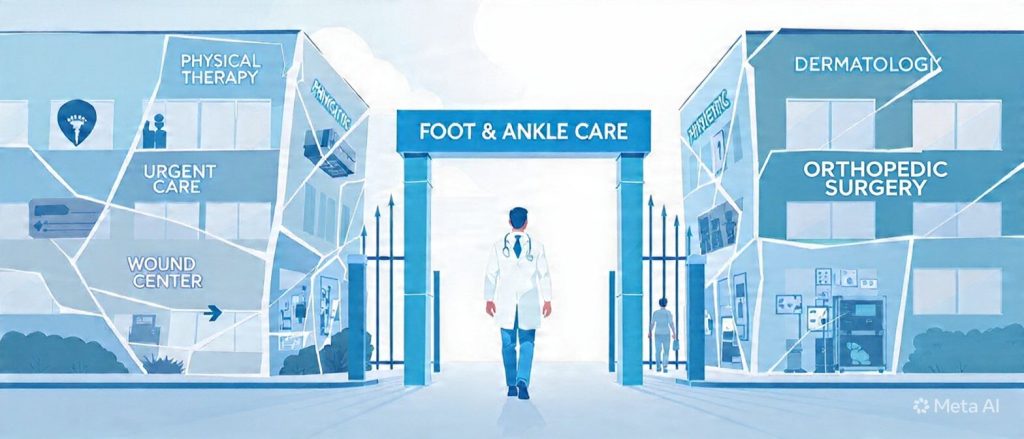
Yet while podiatry was expanding its scope of practice, healthcare itself was changing. Patients no longer follow a single referral pathway. A person with heel pain may begin in physical therapy. An ankle sprain may start in urgent care. A diabetic ulcer may enter through a wound center. Toenail disorders may be seen by dermatology. Foot deformities may be referred directly to orthopedic surgery. Increasingly, patients find providers through internet searches rather than primary care referrals. The result is a fragmented system in which foot and ankle problems are divided among multiple specialties before a comprehensive physician evaluation has occurred.
The consequence is subtle but important. Podiatry has not lost its legal scope of practice, but in many communities it risks losing its position as the first specialty physicians and patients think of for foot and ankle problems. This distinction matters. Scope of practice defines what a profession is trained and authorized to do. Scope of referrals determines which patients actually arrive at its door. A profession may retain broad training while gradually seeing a narrower spectrum of disease.
One possible response to this fragmentation has been an increasing emphasis on surgery as the defining characteristic of podiatry. Surgical expertise unquestionably distinguishes American podiatry and has dramatically improved patient care. However, if surgery becomes the profession’s primary identity, an unintended message may reach the public: “If I don’t need surgery, I probably don’t need a podiatrist.” Patients with heel pain, tendon disorders, sports injuries, stress fractures, diabetic foot problems, or chronic ankle instability may instead begin elsewhere.
Ironically, most podiatric practices are predominantly non-surgical. The majority of patients require physician diagnosis, medical management, biomechanics, orthotics, rehabilitation planning, diabetic risk assessment, or office-based procedures—not reconstructive surgery. Surgery remains an essential part of comprehensive care, but it is not the reason most patients should seek specialty evaluation.
The profession may therefore face what could be called the Entry Point Problem. The question is no longer whether podiatrists are qualified to treat foot and ankle disease. The question is whether patients enter the healthcare system through podiatry at all. When diagnosis begins elsewhere, podiatrists often become consultants for only the portion of care that remains after other specialties have already assumed responsibility.
The solution is not to compete with physical therapists, wound care specialists, dermatologists, orthopedic surgeons, or urgent care physicians. Each plays an important role within modern healthcare. Instead, podiatry should articulate its unique value: physician-level diagnosis and comprehensive management of the foot and ankle. Many conditions involve biomechanics, bone, tendon, nerve, circulation, skin, infection, and systemic disease simultaneously. Before selecting treatment, patients benefit from determining exactly what problem they have.
This suggests a different vision for the specialty. Rather than defining podiatry primarily by surgery, it can define itself by physician-directed diagnosis and continuity of care. The podiatric physician becomes the specialist who evaluates the entire lower extremity, establishes the diagnosis, initiates treatment, performs surgery when necessary, and coordinates care with physical therapy, vascular surgery, infectious disease, dermatology, endocrinology, orthopedics, primary care, and other specialists when appropriate.
The future strength of American podiatry may depend not on performing more surgery, but on reclaiming its role as the physician-first specialty for foot and ankle disease. Surgery, sports medicine, diabetic limb preservation, biomechanics, wound care, and medical management are not competing identities; they are all components of comprehensive specialty care. In an increasingly fragmented healthcare system, patients benefit most when one physician helps guide them through that continuum.
If the profession succeeds in reclaiming that role, podiatry’s greatest contribution to the next generation may not be another surgical procedure or technological innovation. It may be restoring what every specialty ultimately needs: a clear and trusted place as the entry point for the patients it is uniquely trained to serve.
In pain? Don’t wait. Early treatment leads to faster recovery. Urgent appointments available. Read about Conditions We Treat. Request an Appointment online. Call: 206-682-8741 or Contact Us. If you like our content, please link it to your website and Collaborate With Us. Thank you.