
Seattle Foot and Ankle Center | Dr. J. John Hoy, DPM
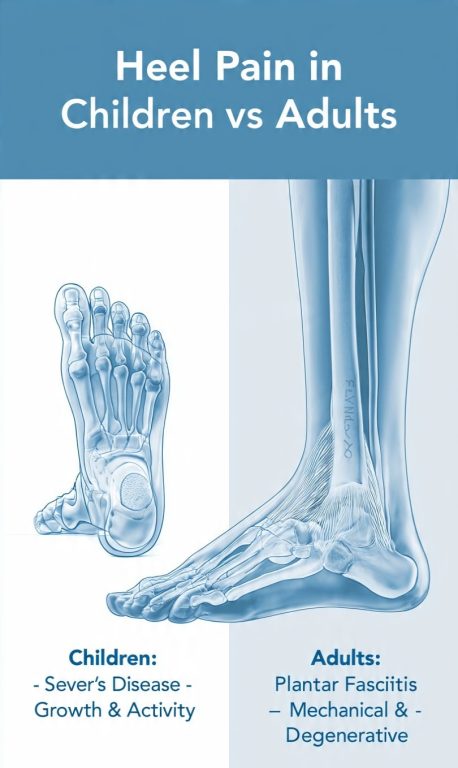
Heel pain is one of the most common reasons patients seek foot and ankle care—but the cause, meaning, and treatment are often very different depending on age.
In children, heel pain is usually related to growth and activity. In adults, it is more often caused by structural overload, tendon strain, or chronic inflammation.
Understanding this difference matters. The wrong assumption can delay healing and lead to persistent or recurring pain.
Heel Pain in Children: Most Often a Growth-Related Condition
The most common cause: Sever’s disease (calcaneal apophysitis)
In active children—especially those who run, play sports, or are very physically active—heel pain is most commonly due to Sever’s disease, a temporary inflammation at the growth plate of the heel.
This is not a “disease” in the traditional sense. It is a stress response in a developing bone.
Typical symptoms in children:
- Pain in the back or bottom of the heel
- Worse with running, jumping, or sports
- Limping after activity
- Pain that improves with rest
- Tenderness when squeezing the sides of the heel
Why it happens:
During growth spurts:
- The heel bone grows faster than the surrounding muscles and tendons
- The Achilles tendon pulls on a sensitive growth plate
- Repetitive sports activity increases stress in the area
This creates pain—but not structural damage in most cases.
Key point:
Children’s heel pain is usually temporary and activity-related, but it should not be ignored if it persists or worsens.
Heel Pain in Adults: A Mechanical and Structural Problem
Unlike children, adults do not have open growth plates. So heel pain in adults almost always reflects a mechanical or degenerative process.
The most common cause: Plantar fasciitis
The plantar fascia is a thick band of tissue supporting the arch. Over time, repetitive stress can lead to microtears and inflammation near the heel.
Other adult causes include:
- Achilles tendinopathy (insertional or mid-portion)
- Heel fat pad irritation or atrophy
- Nerve entrapment (Baxter’s nerve irritation)
- Stress fracture of the calcaneus
- Biomechanical overload from flatfoot or high arch structure
Typical symptoms in adults:
- Sharp pain with first steps in the morning
- Pain after long periods of standing or walking
- Gradual worsening over weeks or months
- Pain that improves slightly with activity, then returns
- Recurrence despite rest or stretching
Why adult heel pain persists:
Adult heel pain is often not just inflammation—it is a load distribution problem:
- Abnormal foot mechanics
- Weakness or tightness in the kinetic chain
- Inadequate support during walking or standing
- Repetitive microtrauma without true recovery
This is why simple rest alone often fails.
The Key Difference: Growth vs. Mechanics
A simple way to think about it:
- Children: heel pain = growth plate stress + activity overload
- Adults: heel pain = biomechanical failure + tissue degeneration
This distinction changes everything about treatment.
Why Misdiagnosis Happens
Heel pain is often labeled generically, but different conditions can look similar:
- Sever’s disease vs Achilles tendonitis
- Plantar fasciitis vs nerve pain
- Fat pad pain vs stress fracture
- Overuse pain vs structural instability
Without a focused examination, patients may:
- Stretch the wrong structure
- Use ineffective treatments for months
- Delay recovery
- Develop chronic or recurrent pain patterns
When to Seek Specialist Evaluation
Heel pain should be evaluated if:
- Pain lasts more than 1–2 weeks in a child
- Pain persists more than 2–3 weeks in an adult
- Symptoms interfere with walking, sports, or work
- Pain keeps returning after improvement
- Home care, rest, or physical therapy has not resolved symptoms
- There is limping or difficulty bearing weight
Early evaluation helps identify whether the problem is:
- Growth-related (children)
- Mechanical (adults)
- Or something more complex requiring imaging or advanced treatment
How Dr. J. John Hoy Approaches Heel Pain
At Seattle Foot and Ankle Center, heel pain is evaluated through a diagnostic-first approach, not a one-size-fits-all label.
Evaluation focuses on:
- Biomechanical structure of the foot and ankle
- Gait and pressure distribution patterns
- Tendon and fascia integrity
- Growth plate status in pediatric patients
- Imaging when needed to confirm diagnosis
Treatment may include:
- Activity modification strategies
- Targeted stretching and strengthening protocols
- Custom or over-the-counter orthotics
- Shockwave therapy for chronic cases
- Immobilization when necessary
- Surgical options only in persistent, structural cases
The goal is not just pain relief—but correction of the underlying cause to prevent recurrence.
The Bottom Line
Heel pain is not one condition. It is a symptom with different meanings depending on age.
- In children, it is usually related to growth and activity load
- In adults, it is usually a mechanical or degenerative overload problem
Getting the diagnosis right early can significantly shorten recovery time and prevent long-term recurrence.
Schedule an Evaluation
If heel pain is affecting walking, sports, or daily life, a focused evaluation can often provide clarity in a single visit.
Seattle Foot and Ankle Center
Dr. J. John Hoy, DPM
📍 Seattle, WA
👉 Call or schedule an appointment online to get a clear diagnosis and treatment plan tailored to your condition.
In pain? Don’t wait. Early treatment leads to faster recovery. Urgent appointments available. Read about Conditions We Treat. Request an Appointment online. Call: 206-682-8741 or Contact Us. Refer a Patient. If you like our content, please link it to your website. Thank you.