
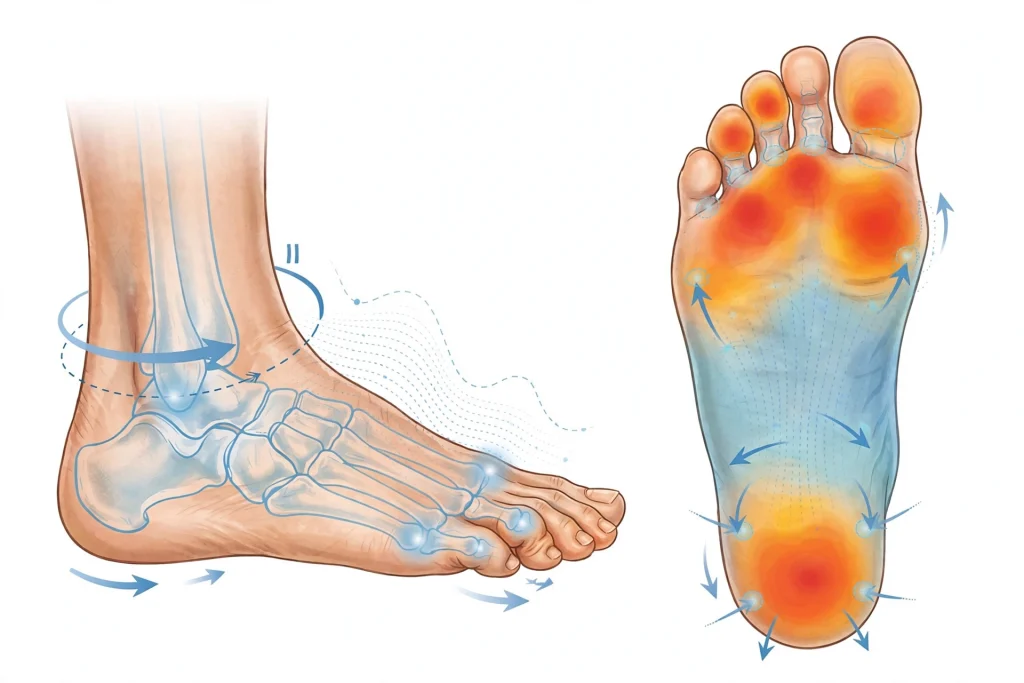
A diabetic foot ulcer may heal only to return in the same location months or even years later. When that happens, the problem is not necessarily that the wound was treated incorrectly. In many cases, the wound healed—but the mechanical forces that caused it were never fully addressed.
This is one of the most important concepts in diabetic foot care: healing the wound is not the same as eliminating the reason the wound developed.
Pressure, shear, deformity, limited joint motion, muscle imbalance, footwear, and the way a person walks can all influence where excessive stress is concentrated on the foot. When protective sensation is reduced, a person may not feel those forces building up.
Understanding the biomechanics behind diabetic foot ulcers is therefore an important part of both treatment and prevention.
Why Does a Diabetic Foot Ulcer Keep Coming Back?
Diabetic foot ulcers commonly develop when repeated mechanical stress is applied to tissue that cannot adequately tolerate it.
A person may walk thousands of steps each day. With every step, forces are transmitted through the heel, midfoot, forefoot, and toes. Normally, pain and discomfort help us recognize when an area is being overloaded.
Peripheral neuropathy can change that.
When protective sensation is reduced, a person may continue walking normally despite excessive pressure or repetitive irritation. The skin can become damaged gradually without producing the warning symptoms that would normally cause someone to stop.
The result can be a cycle:
Mechanical stress → tissue damage → ulcer → healing → return to the same mechanical stress → recurrent ulcer
Breaking that cycle requires more than treating the wound itself.
The Role of Pressure
Pressure is one of the most important mechanical factors in diabetic ulcer formation.
Certain areas of the foot naturally experience greater loading during walking. Abnormal pressure can become concentrated around a prominent metatarsal head, a rigid or deformed toe, a plantar bony prominence, or another area that repeatedly contacts the ground or footwear.
Pressure becomes particularly important when the tissues are exposed to it repeatedly.
A single step may not cause an ulcer. Thousands of steps over days and weeks can produce cumulative tissue stress.
This is why a wound can heal when walking is reduced or the area is appropriately offloaded, only to return after the patient resumes normal activity.
Shear Forces Matter Too
Pressure is not the only mechanical problem.
Shear occurs when layers of tissue experience forces that move them in different directions. During walking, the foot can move inside a shoe or against the ground while the skin and deeper tissues respond differently.
Shear can contribute to tissue breakdown, particularly when combined with repetitive loading.
This is one reason that simply looking at the wound is not always enough. The appearance of the ulcer tells us what has happened to the tissue. The mechanics of the foot can help explain why it happened there in the first place.
Foot Deformity Can Create a Repeated Pressure Point
Structural changes in the diabetic foot can alter the distribution of pressure.
Examples include:
- Prominent metatarsal heads
- Hammertoes and other digital deformities
- Hallux deformity
- Charcot foot deformity
- Collapsed or altered arch structure
- Rigid joints
- Amputation-related changes in foot structure
A deformity does not automatically cause an ulcer. The concern arises when the altered structure creates a location that repeatedly experiences excessive pressure or shear.
If the wound heals but the deformity and mechanical loading remain unchanged, recurrence may be predictable.
Limited Joint Motion Can Change How the Foot Loads
Joint motion is another important part of foot biomechanics.
For example, limited ankle dorsiflexion can alter the way the foot progresses through the stance phase of walking. Changes in motion at one joint can influence loading elsewhere in the foot.
The first metatarsophalangeal joint is also important during the later portion of the walking cycle. If motion is restricted, abnormal loading may develop beneath the forefoot.
These relationships are not the explanation for every diabetic ulcer, but they are part of the broader mechanical assessment.
The important question is not simply:
“Where is the ulcer?”
It is also:
“What is happening mechanically at that location every time this patient walks?”
Neuropathy Changes the Warning System
Biomechanics become particularly important when protective sensation is reduced.
A person with normal sensation may feel pain, burning, or tenderness when a shoe is rubbing or when a particular part of the foot is being overloaded. That discomfort can prompt a change in activity or footwear.
With peripheral neuropathy, those warning signals may be diminished or absent.
A patient may therefore continue walking on an area that is being repeatedly injured.
This is why diabetic foot care cannot rely solely on whether the patient reports pain.
A painless foot can still be an injured foot.
Why Offloading Is So Important
When a diabetic ulcer develops, reducing mechanical stress on the wound is a fundamental part of treatment.
This is known as offloading.
The goal is to reduce the forces reaching the ulcer sufficiently to allow the tissue to heal while also addressing the patient’s overall mobility and safety.
Depending on the wound and the patient’s circumstances, offloading may involve specialized footwear, orthotic devices, removable devices, accommodative modifications, or other approaches.
The correct method depends on the location and severity of the ulcer, the patient’s vascular status, neuropathy, deformity, mobility, and ability to follow the treatment plan.
Offloading is not simply “putting something soft under the foot.”
It is a mechanical intervention designed to change how forces are transmitted through the foot.
Healing the Ulcer Is Only the First Step
A wound can close completely and still remain at high risk for recurrence.
Once the skin has healed, the patient may return to the same shoes, walking pattern, activity level, and mechanical environment that contributed to the original ulcer.
If those factors have not changed, the newly healed tissue may once again be exposed to excessive stress.
This is why diabetic limb preservation involves more than wound closure.
After healing, the question becomes:
How do we keep the ulcer from coming back?
That may involve therapeutic footwear, custom accommodative devices, activity modification, regular foot examinations, management of deformity, and ongoing monitoring of high-risk areas.
The Importance of Looking Beyond the Wound
A diabetic foot ulcer should be evaluated as part of the entire foot—not simply as a hole in the skin.
A comprehensive evaluation considers factors such as:
- Neuropathy and protective sensation
- Circulation and vascular status
- Foot deformity
- Joint range of motion
- Muscle and tendon function
- Weight-bearing mechanics
- Pressure distribution
- Footwear
- Activity level
- Previous ulcer location and recurrence
- History of amputation or Charcot deformity
This broader assessment can help identify factors that need to be addressed in addition to the wound itself.
For some patients, the primary concern may be vascular. For others, infection may be the immediate issue. In another patient, mechanical overload may be a major contributor.
Often, several factors coexist.
When Surgery May Be Part of Ulcer Prevention
Most diabetic foot ulcers do not automatically require surgery.
However, some recurrent ulcers are associated with a structural problem that cannot be adequately accommodated with footwear or other conservative measures.
In selected cases, surgical correction may be considered to remove a prominent area, correct a deformity, or otherwise reduce repetitive mechanical stress.
The decision depends on the patient’s overall health, circulation, infection status, neuropathy, deformity, functional needs, and other clinical factors.
The principle remains the same:
Treat the wound, but also address the reason the wound keeps occurring.
Preventing the Next Ulcer
For someone who has already had a diabetic foot ulcer, prevention becomes an ongoing process.
Practical measures may include:
- Daily inspection of the feet
- Appropriate diabetic footwear
- Avoiding walking barefoot when protective sensation is reduced
- Regular professional foot examinations
- Prompt attention to redness, blistering, drainage, or skin breakdown
- Following prescribed offloading recommendations
- Monitoring areas where previous ulcers developed
- Addressing significant deformities or mechanical problems when appropriate
Patients with neuropathy may need to rely on visual inspection rather than pain to identify problems early.
A small area of redness or irritation can be an important warning sign.
What is the Bottom Line on Recurrent Diabetic Foot Ulcers?
A recurrent diabetic foot ulcer is not always simply a wound that “didn’t heal properly.”
Sometimes the wound healed exactly as expected—but the mechanical environment that caused the injury remained unchanged.
Pressure, shear, deformity, limited joint motion, footwear, activity, and altered walking mechanics can all contribute to repetitive tissue stress. When protective sensation is reduced, the patient may not feel that damage occurring.
That is why diabetic limb preservation requires attention to both the wound and the foot that produced it.
At Seattle Foot and Ankle Center, Dr. J. John Hoy evaluates diabetic foot problems comprehensively, including wound care, vascular and neurologic considerations, deformity, biomechanics, offloading, and surgical treatment when appropriate.
If a diabetic foot wound keeps returning, the important question is not only how to heal it again—but why it keeps happening.
In pain? Don’t wait. Early treatment leads to faster recovery. Urgent appointments available. Read about Conditions We Treat. Request an Appointment online. Call: 206-682-8741 or Contact Us. If you like our content, please link it to your website and Collaborate With Us. Thank you.