
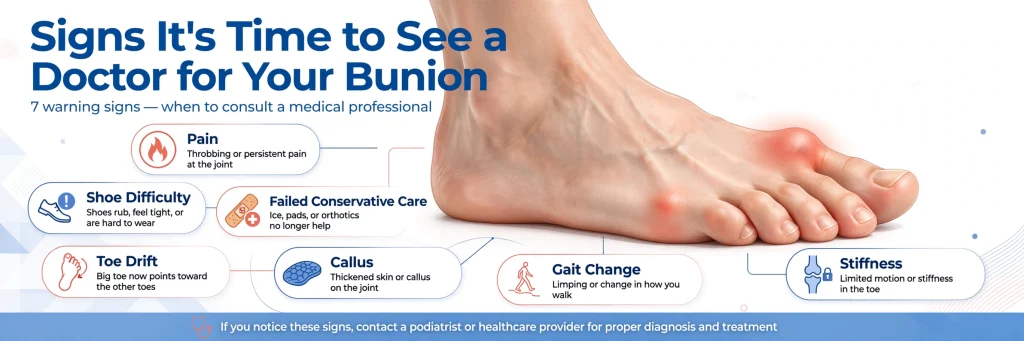
A bunion can start as a small bump along the inside of the big toe. At first, it may cause little more than a cosmetic concern or occasional irritation from shoes. Over time, however, a bunion can become painful, change the alignment of the big toe, and affect how the entire foot functions.
A bunion warrants a doctor's evaluation when it begins to affect comfort, mobility, footwear, or quality of life, even if surgery isn't immediately necessary. Key signs to look for include increasing pain, difficulty finding comfortable shoes, or the big toe progressively moving further toward the smaller toes. Seattle Foot and Ankle Center advises seeking professional assessment if a bunion causes pain after prolonged walking, during exercise, or interferes with normal activities. These symptoms indicate the problem deserves a proper diagnosis and treatment plan.
The important question isn’t simply whether you have a bunion. It is whether the bunion is beginning to affect your comfort, mobility, footwear, or quality of life.
Not every bunion requires surgery, and not every bunion needs to be treated immediately. But certain changes are signs that it is time to have the foot evaluated by a doctor.
What Is a Bunion?
A bunion, or hallux valgus, is a structural deformity involving the big toe and the first metatarsal. The big toe gradually moves toward the smaller toes while the first metatarsal shifts toward the inside of the foot, creating the familiar prominence at the base of the big toe.
A bunion is therefore more than a bump that can simply be “removed.” It reflects changes in the alignment and mechanics of the forefoot.
Some bunions remain relatively stable and cause few symptoms. Others progressively become more painful or begin affecting walking and footwear.
Is Your Bunion Becoming Painful?
Pain is one of the clearest reasons to have a bunion evaluated.
Bunion pain may occur directly over the prominence, particularly when shoes rub against it. You may also experience pain around the big-toe joint, underneath the forefoot, or elsewhere in the foot as pressure distribution changes.
Pay attention to patterns such as:
- Pain after prolonged walking or standing
- Pain during exercise
- Pain when wearing particular shoes
- Pain that is becoming more frequent
- Pain that continues even after changing footwear
- Pain that interferes with normal activities
A painful bunion does not automatically mean that surgery is necessary. It does mean that the problem deserves a proper diagnosis and treatment plan.
Are Your Shoes Becoming Difficult to Wear Due to a Bunion?
One of the earliest functional problems caused by a bunion can be difficulty finding comfortable shoes.
You may notice that:
- Your usual shoes rub against the bunion.
- You need increasingly wider shoes.
- Certain shoes are no longer tolerable.
- The skin over the bunion becomes irritated or thickened.
- You avoid activities because you cannot find comfortable footwear.
Changing to shoes with a wider toe box can reduce pressure and may be all that is needed for a mild, minimally symptomatic bunion.
However, if footwear choices are becoming increasingly restrictive, an evaluation can determine whether the underlying deformity is contributing to the problem.
Is Your Big Toe Moving Toward Smaller Toes?
A bunion can change over time.
If you notice the big toe progressively moving toward the second toe, increasing crowding, or difficulty separating the toes normally, it is worth having the deformity assessed.
The appearance of the foot is not the only consideration. Changes in alignment can alter how forces move through the first metatarsophalangeal joint and the rest of the forefoot.
Early evaluation does not necessarily mean early surgery. It provides an opportunity to understand the deformity and discuss appropriate options before symptoms become more limiting.
Are You Developing Corns, Calluses, or Skin Irritation?
Changes in pressure can cause thickened skin to develop around the bunion or elsewhere on the foot.
For example, you may develop irritation where the bunion rubs against your shoe. You may also develop calluses underneath the forefoot if weight is being distributed differently.
A recurring callus is often a clue that abnormal pressure is occurring.
Simply removing the callus may provide temporary relief, but it is also important to understand why that area is repeatedly receiving excessive pressure.
Is Your Walking Pattern Changing Due to a Bunion?
This is an especially important warning sign.
If you are beginning to limp, avoid pushing off your big toe, shift your weight toward another part of the foot, or otherwise change how you walk because of your bunion, the deformity is affecting function.
You may not consciously notice these changes. Sometimes a spouse, family member, or friend notices that you are walking differently before you do.
A change in gait can also place additional stress on other areas of the foot and lower extremity.
Is Your Big-Toe Joint Becoming Stiff?
Bunions can be associated with changes in motion at the big-toe joint.
If the joint becomes increasingly stiff, painful, or difficult to move, the diagnosis may involve more than the visible bunion itself. Arthritis or other changes within the joint may contribute to the symptoms.
This is one reason a comprehensive examination is more useful than simply evaluating the appearance of the bump.
Are Conservative Bunion Treatments No Longer Enough?
Many people can manage a mildly symptomatic bunion with conservative measures.
Depending on the individual situation, these may include:
- Shoes with a wider toe box
- Activity modification
- Padding to reduce pressure
- Appropriate over-the-counter inserts
- Orthotics when indicated
- Exercises or rehabilitation
- Treatment of associated foot problems
But if you have been making these changes and your symptoms continue to worsen, it is time to reassess the diagnosis and treatment strategy.
The next step isn’t automatically surgery. It is determining why the current approach isn’t adequately controlling the problem.
Does Every Bunion Need Surgery?
No.
This is one of the most important things to understand about bunions.
A bunion is generally treated based on symptoms and functional limitations, not simply because the foot looks different.
If a bunion causes no meaningful pain or functional limitation, observation may be appropriate.
When symptoms become significant and appropriate conservative treatment no longer provides adequate relief, surgery may become a reasonable option. The specific procedure depends on the type and severity of the deformity, joint condition, overall foot structure, and other individual factors.
There is no single bunion operation that is appropriate for everyone.
Why a Proper Bunion Evaluation Matters
A bunion should be evaluated as part of the entire foot rather than simply as a bump.
A podiatric examination may assess:
- Big-toe alignment
- First metatarsal position
- Joint range of motion
- Forefoot structure
- Other toe deformities
- Foot mechanics and gait
- Areas of abnormal pressure
- Skin changes
- The condition of the big-toe joint
- Other factors contributing to pain
Weight-bearing X-rays may also be appropriate to evaluate bone alignment and the severity of the deformity.
The purpose of the evaluation is to establish what is actually causing the symptoms and determine whether observation, conservative care, or surgical treatment is appropriate.
When Should You See a Doctor About a Bunion?
You don’t need to wait until a bunion becomes severely painful before having it evaluated.
Consider making an appointment if:
- Your bunion has become painful.
- Your shoes are increasingly difficult to wear.
- The deformity appears to be progressing.
- Your big toe is crowding or crossing toward the second toe.
- You are developing recurrent corns or calluses.
- The joint is becoming stiff.
- Your bunion is changing the way you walk.
- Conservative measures are no longer providing adequate relief.
- Foot pain is limiting exercise, work, walking, or other activities you value.
The goal of an evaluation is not necessarily to recommend surgery. It is to understand the condition and determine what, if anything, needs to be done.
Why Shouldn't You Wait to Treat Your Bunion?
A bunion can remain a minor inconvenience for years—or gradually become a significant source of pain and functional limitation.
The right time to seek evaluation is not determined by how large the bump looks. It is determined by what the bunion is doing to your foot and your life.
At Seattle Foot and Ankle Center, Dr. J. John Hoy takes a diagnosis-first approach to bunion and forefoot problems. Conservative treatment is considered first when appropriate, with surgical correction reserved for cases where the deformity and symptoms warrant it.
If your bunion is becoming painful, limiting your footwear, or changing the way you walk, an evaluation can help you understand your options.
You don’t have to wait until your bunion becomes unbearable to find out what can be done.
Frequently Asked Questions
You should consider an evaluation when a bunion becomes painful, interferes with footwear or activities, changes your walking pattern, progresses noticeably, or does not respond adequately to conservative measures.
Bunions can progressively change in some people, although the rate and degree of progression vary. A foot examination can help determine the current severity of the deformity and whether other problems are contributing to symptoms.
No. Many bunions can be managed conservatively, particularly when symptoms are mild. Surgery may be considered when pain and functional limitations persist despite appropriate nonoperative treatment.
Yes. Shoes with adequate room in the toe box can reduce pressure on the bunion and may significantly improve symptoms. However, wider shoes do not correct the underlying structural deformity.
Usually, treatment decisions are based primarily on symptoms and functional limitations rather than appearance alone. The severity and type of deformity, joint condition, and response to conservative treatment also influence treatment decisions.
Yes. Pain or altered big-toe alignment can change how you distribute pressure through the foot and how you push off while walking. If a bunion is causing you to change your gait, it is worth having the foot evaluated.
In pain? Don’t wait. Early treatment leads to faster recovery. Urgent appointments available. Read about Conditions We Treat. Request an Appointment online. Call: 206-682-8741 or Contact Us. If you like our content, please link it to your website and Collaborate With Us. Thank you.