
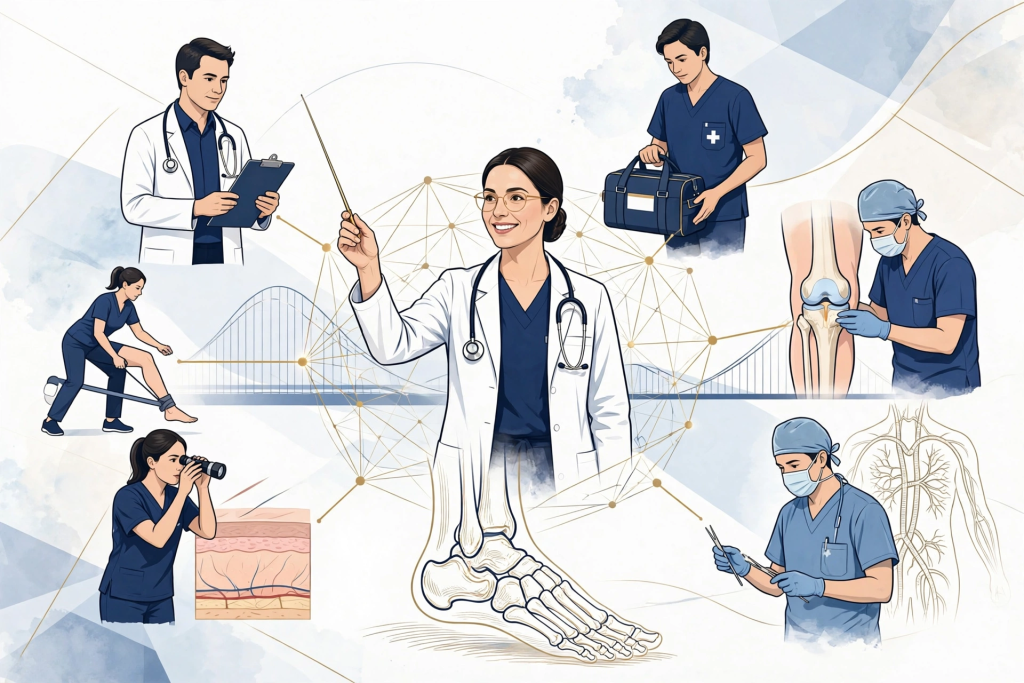
Healthcare has changed.
Patients no longer move through a simple pathway from primary care physician to the appropriate specialist. Instead, modern medicine has evolved into a network of specialized services, each designed to address specific aspects of patient care.
For foot and ankle conditions, this has created increasingly fragmented pathways.
A patient with heel pain may be sent directly to physical therapy.
A patient with an ankle injury may be evaluated in urgent care and referred elsewhere.
A diabetic patient with a foot ulcer may enter a wound care program.
A painful bunion may be directed toward orthopedic surgery.
A skin condition involving the foot may be sent to dermatology.
Each of these professionals provides valuable expertise. The challenge is not that these specialties exist. The challenge is that patients may not always reach the physician whose training encompasses the entire spectrum of foot and ankle disease.
This creates both a challenge and an opportunity for podiatric medicine.
The solution is not to resist collaboration.
The solution is to lead through collaboration.
What Does Collaboration Mean?
Collaboration is the process of individuals and organizations working together toward a shared goal by combining their knowledge, skills, and resources while respecting each participant’s expertise and role.
In healthcare, collaboration requires:
- Communication
- Mutual respect
- Shared decision-making
- Coordinated treatment plans
- Recognition of each professional’s strengths
Collaboration is not simply sending a referral.
It is creating a healthcare environment where the right professional is involved at the right time, with clear communication among everyone caring for the patient.
Collaboration Requires Confidence, Not Competition
Some may view collaboration as a sign that a specialty must give up its identity or expertise.
The opposite is true.
The strongest healthcare teams work because each member understands and contributes their unique training.
Cardiologists collaborate with cardiac surgeons.
Oncologists collaborate with radiation specialists.
Primary care physicians collaborate with specialists across medicine.
No specialty becomes less valuable by working with others.
Podiatric physicians should approach collaboration the same way.
We do not collaborate because our role is limited.
We collaborate because our expertise is important.
The Unique Role of the Podiatric Physician
Modern podiatric medicine is built around comprehensive care of the foot and ankle.
Podiatric physicians diagnose and treat conditions involving:
- Biomechanics and gait
- Sports injuries
- Heel pain
- Tendon disorders
- Fractures and trauma
- Arthritis
- Foot deformities
- Diabetic limb preservation
- Wounds and infections
- Pediatric disorders
- Skin and nail conditions
- Reconstructive surgery
This breadth provides podiatric physicians with a unique perspective.
A patient with foot pain does not always need surgery.
A patient with a wound does not always need a procedure.
A patient with an injury does not always need rehabilitation alone.
The role of the podiatric physician is to evaluate the problem, establish the diagnosis, determine the appropriate treatment pathway, and coordinate care when additional expertise is needed.
Building Stronger Relationships With Primary Care
Primary care physicians are among the most important partners in improving foot and ankle care.
They manage complex patients with diabetes, cardiovascular disease, arthritis, and multiple medical conditions. They cannot be expected to master every detail of every specialty.
Collaboration with primary care means:
- Providing timely access.
- Communicating clearly after consultations.
- Helping identify patients at risk for complications.
- Explaining treatment options.
- Making the referral process easy.
The goal is not to replace primary care.
The goal is to become a trusted extension of it.
Working With Physical Therapists
Physical therapists provide essential expertise in rehabilitation, mobility, strength, and functional recovery.
A collaborative relationship recognizes that:
- Some conditions respond well to therapy alone.
- Some conditions require physician diagnosis before rehabilitation begins.
- Many patients benefit from both medical evaluation and therapy.
The most effective pathway is not:
Podiatry versus physical therapy.
It is:
Diagnosis → appropriate treatment plan → rehabilitation when indicated → communication throughout recovery.
Working With Other Specialists
Foot and ankle conditions frequently involve multiple areas of medicine.
Successful care may require collaboration with:
- Vascular surgeons
- Infectious disease specialists
- Endocrinologists
- Dermatologists
- Rheumatologists
- Orthopedic surgeons
- Wound care teams
Diabetic limb preservation demonstrates this model clearly. The best outcomes occur when specialists combine their expertise around the patient rather than work in isolation.
Educate Without Creating Conflict
One of the greatest challenges facing podiatric medicine is that many people still do not understand the scope of modern podiatric training.
Some patients still associate podiatry primarily with routine foot care.
Some healthcare professionals may not be familiar with the depth of podiatric residency training.
These misunderstandings are not solved through criticism.
They are solved through education.
Every consultation note, referral relationship, hospital interaction, community presentation, and patient encounter is an opportunity to demonstrate the role of the podiatric physician.
Become the Physician Who Brings the Pieces Together
Fragmentation creates confusion.
Patients often do not know where to start.
Should they see primary care?
Physical therapy?
Orthopedics?
Urgent care?
Dermatology?
The podiatric physician has an opportunity to become the physician who brings those pieces together.
By evaluating the entire foot and ankle problem, determining the appropriate pathway, and coordinating care with other professionals, podiatric physicians provide something increasingly valuable in modern healthcare:
Integration.
The Future of Podiatry Is Collaborative Leadership
The future of podiatric medicine will not be secured by competing over every condition or criticizing other healthcare professionals.
It will be secured by demonstrating value.
The podiatric physicians who thrive will be those who:
- Deliver excellent clinical care.
- Communicate effectively.
- Build referral relationships.
- Educate healthcare partners.
- Collaborate confidently.
- Advocate for comprehensive foot and ankle care.
Collaboration is not a compromise of our profession.
It is a demonstration of our maturity as physicians.
In a fragmented healthcare system, the podiatric physician who collaborates effectively does not become less relevant.
The podiatric physician becomes the professional who helps bring fragmented care back together.
In pain? Don’t wait. Early treatment leads to faster recovery. Urgent appointments available. Read about Conditions We Treat. Request an Appointment online. Call: 206-682-8741 or Contact Us. Refer a Patient. If you like our content, please link it to your website. Thank you.