
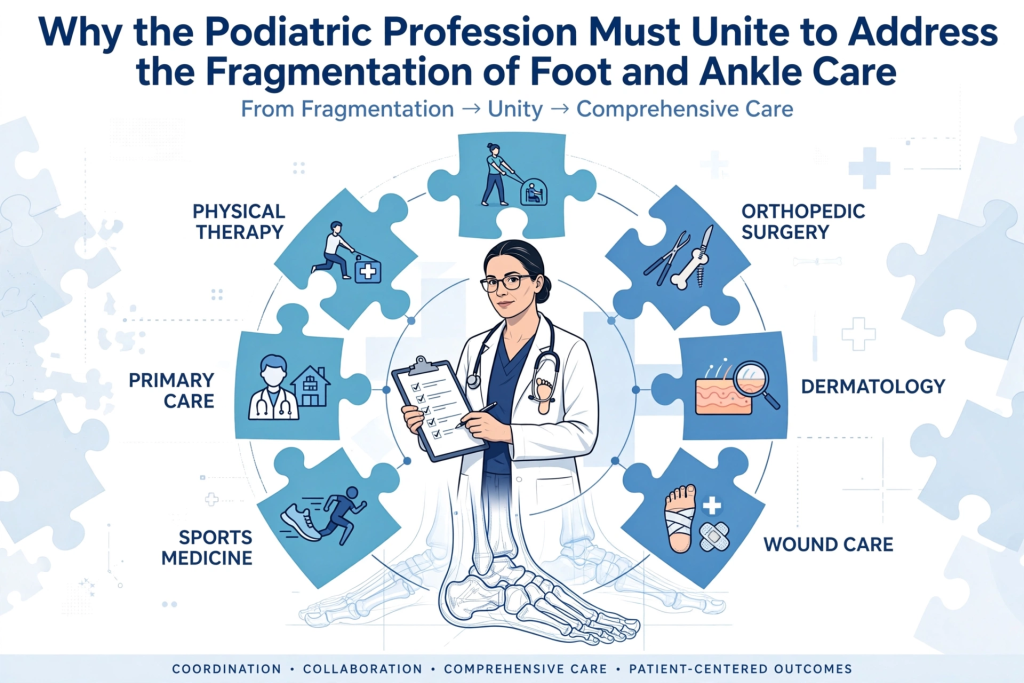
The podiatric profession must unite to address the fragmentation of foot and ankle care because podiatrists are uniquely trained to provide comprehensive, diagnosis-first care for the entire anatomical region. Unlike other specialists who often focus on isolated aspects, podiatric physicians have built a profession over more than a century dedicated exclusively to the foot and ankle. This fragmentation creates patient confusion, delays diagnosis, duplicates treatments, and increases healthcare costs by dividing care into disconnected pieces.
For more than a century, podiatric physicians have built a profession uniquely dedicated to one part of the human body: the foot and ankle. Over decades, we have established rigorous medical education, hospital-based surgical residency training, board certification, and expertise that spans biomechanics, sports medicine, diabetic limb preservation, wound care, reconstructive surgery, pediatric foot disorders, dermatologic conditions, and routine foot care.
Yet despite these advances, foot and ankle care has become increasingly fragmented.
Today, patients often enter a maze of disconnected providers. A runner with heel pain may see physical therapy first. A patient with a painful bunion may be referred to orthopedic surgery. A diabetic ulcer may be managed by a wound care center before a podiatrist is involved. Foot skin conditions may go first to dermatology. Patients with neuropathy may see neurology, while ankle injuries are evaluated in urgent care or sports medicine clinics.
Each of these specialists provides valuable expertise. The problem is not that these disciplines exist—it is that foot and ankle care has become divided into isolated pieces instead of coordinated around physicians whose entire medical careers focus on this anatomical region.
We Are the Only Physicians Dedicated to the Entire Foot and Ankle
Every specialty naturally views problems through its own training.
Physical therapists emphasize rehabilitation.
Orthopedic surgeons often focus on surgical reconstruction.
Dermatologists evaluate skin disease.
Wound centers concentrate on ulcer management.
Sports medicine physicians focus on athletic injuries.
Primary care physicians manage overall health.
Podiatric physicians are different.
Our education and residency are devoted exclusively to the diagnosis and treatment of foot and ankle disease across all ages and levels of complexity. We are trained to determine whether a patient needs conservative care, rehabilitation, injections, orthotics, imaging, surgery, vascular evaluation, infectious disease consultation, or referral to another specialist when appropriate.
That comprehensive perspective is increasingly valuable in today’s complex healthcare environment.
How does fragmentation create confusion in foot and ankle care?
Fragmentation creates confusion in foot and ankle care by delaying diagnosis, duplicating treatments, interrupting communication, and increasing costs, as patients struggle to know which specialist to see. Patients frequently ask: “Should I see orthopedics?” “Do I need physical therapy first?” “Should I go to a wound center?” “Does dermatology treat this?” Most importantly, patients often lose the benefit of having one physician coordinate the overall management of their foot and ankle condition.
“Should I see orthopedics?”
“Do I need physical therapy first?”
“Should I go to a wound center?”
“Does dermatology treat this?”
The fact that patients struggle to know where to begin reflects a larger system problem.
When care becomes fragmented, diagnosis may be delayed, treatments duplicated, communication interrupted, and costs increased.
Most importantly, patients often lose the benefit of having one physician coordinate the overall management of their foot and ankle condition.
Why must podiatric physicians better tell their story about modern foot and ankle care?
One reason fragmentation has accelerated is that many patients—and even many healthcare professionals—do not fully understand the scope of modern podiatric medicine.
Many still associate podiatry primarily with nail care or diabetic foot checks.
In reality, today’s podiatric physician diagnoses and manages:
- Sports injuries
- Arthritis
- Tendon disorders
- Fractures
- Heel pain
- Nerve entrapments
- Pediatric deformities
- Limb preservation
- Foot and ankle infections
- Skin disorders affecting the feet
- Custom orthotics
- Biomechanics
- Reconstructive surgery
- Trauma
- Complex deformity correction
If we do not communicate this message consistently, others will define our profession for us.
Why is unity essential for the podiatric profession in foot and ankle care?
Individual practices can educate their own communities, but lasting change requires collective effort.
Professional organizations, residency programs, educators, hospital leaders, and practicing podiatrists should work together to present a clear and unified message:
Podiatric physicians are the medical specialists dedicated to comprehensive foot and ankle care.
This message should appear consistently across:
- Practice websites
- Patient education materials
- Referral outreach
- Hospital systems
- Medical schools
- Residency recruitment
- Public awareness campaigns
- Social media
- Community education
The public should no longer wonder which specialist manages foot and ankle problems. The answer should be clear: podiatric physicians are often the most appropriate first point of evaluation for conditions involving the foot and ankle.
Why is collaboration, not competition, important for podiatric foot and ankle care?
This is not a call to replace other specialists.
Excellent patient care depends on collaboration with orthopedic surgeons, vascular surgeons, dermatologists, infectious disease physicians, endocrinologists, rheumatologists, physical therapists, primary care physicians, emergency medicine physicians, and many others.
The goal is not ownership of every condition.
The goal is ensuring that podiatric physicians are recognized as integral physicians in the diagnosis, coordination, and management of foot and ankle disease.
Patients benefit most when every specialist contributes their expertise while working together rather than in parallel.
What is the future outlook for podiatric medicine and foot and ankle care?
Healthcare continues to move toward multidisciplinary, patient-centered care. Podiatric medicine is exceptionally well positioned to lead within that model because our training spans medicine, surgery, biomechanics, wound care, preventive care, and rehabilitation.
But leadership requires visibility.
If we remain passive, fragmentation will continue, referral pathways will become increasingly disconnected, and public understanding of our profession will continue to erode.
If we speak with one voice, educate consistently, support one another, and demonstrate the full breadth of our training every day, podiatric medicine can strengthen its role as the physician specialty dedicated to comprehensive foot and ankle care.
The profession has never been stronger clinically. Our next challenge is ensuring that patients, healthcare systems, policymakers, and referring providers understand the value we bring. Meeting that challenge will require unity—not only within our practices, but across the profession itself.
In pain? Don’t wait. Early treatment leads to faster recovery. Urgent appointments available. Read about Conditions We Treat. Request an Appointment online. Call: 206-682-8741 or Contact Us. If you like our content, please link it to your website and Collaborate With Us. Thank you.