
Podiatric medicine must overcome its internal divisions to maintain its recognized role as the sole physician profession exclusively devoted to comprehensive foot and ankle care amidst increasing healthcare fragmentation. Internal fragmentation, such as perceiving foot and ankle surgery as a separate profession rather than a specialty within podiatric medicine, diminishes the profession's collective identity and breadth. Furthermore, ongoing debates between certifying boards regarding standards and pathways create visible divisions that can undermine confidence among hospitals, patients, and referring physicians. By presenting a unified front, podiatry can better advocate for its comprehensive expertise, which includes physicians completing four years of medical education and three years of hospital-based residency training.
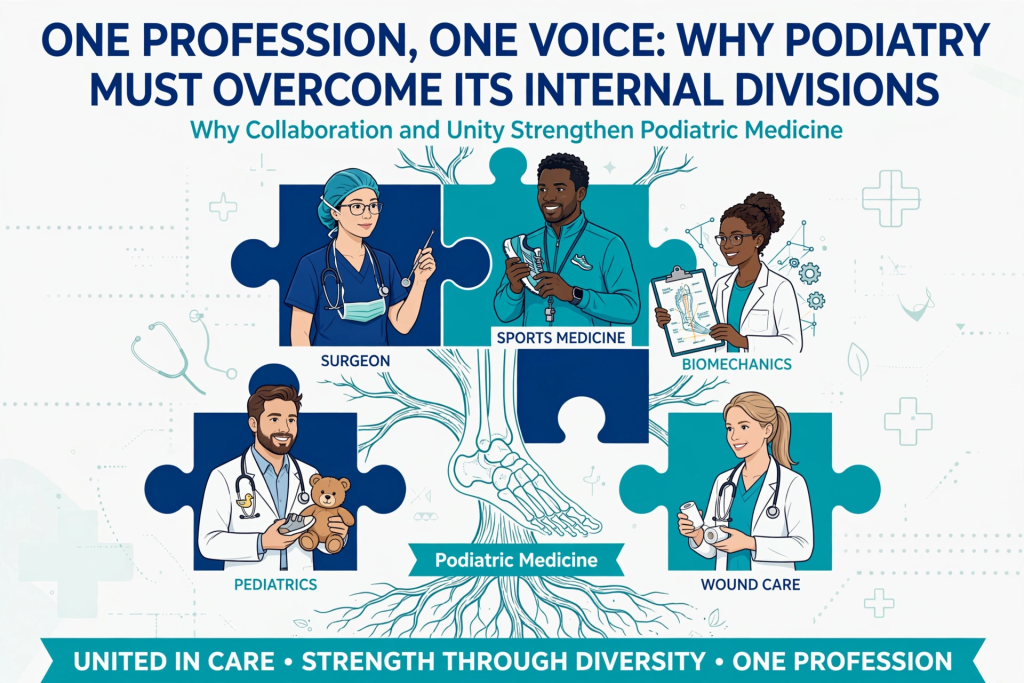
Modern podiatric medicine has never been stronger.
Today’s podiatric physicians complete four years of medical education, three years of comprehensive hospital-based residency training, and pursue board certification in areas ranging from comprehensive podiatric medicine to foot and ankle surgery. We diagnose, treat, and operate on conditions spanning sports injuries, diabetic limb preservation, biomechanics, wound care, pediatric disorders, dermatologic conditions, trauma, and reconstructive surgery.
Yet, at a time when healthcare is increasingly fragmenting foot and ankle care among multiple specialties, we continue to fragment ourselves.
That should concern every podiatric physician.
Why Must Podiatry Overcome Internal Divisions to Address External Challenges?
Patients with foot and ankle problems are increasingly routed through a complex healthcare system. One patient is referred to physical therapy, another to orthopedics, another to a wound center, another to dermatology, and another to sports medicine.
Each specialty provides valuable expertise, but podiatric medicine remains the only physician profession devoted exclusively to the comprehensive care of the foot and ankle.
If we expect healthcare systems, referring providers, and patients to recognize that role, we must first present ourselves as a unified profession.
Unfortunately, we often do the opposite.
Surgery Is Part of Podiatric Medicine—Not Separate From It
One trend that deserves thoughtful discussion is the way we describe surgical practice.
Foot and ankle surgery is an essential specialty within podiatric medicine. Surgical organizations have advanced education, research, and patient care for decades, and podiatric surgeons have made enormous contributions to reconstructive surgery, trauma, diabetic limb preservation, and deformity correction.
But surgery is a specialty—it is not a separate profession.
Every podiatric surgeon is first a podiatric physician.
Likewise, not every podiatric physician builds a practice centered on surgery. Many dedicate their careers to biomechanics, sports medicine, diabetic care, wound care, pediatric foot disorders, preventive care, or comprehensive medical management. These physicians are no less important to the profession.
When we imply that surgery represents an identity apart from podiatric medicine, we unintentionally diminish the profession that created that expertise in the first place.
Our strength has always been our breadth.
Board Certification Should Unite, Not Divide
Another area where division has become too visible is board certification.
The ongoing debate between our certifying boards reflects two legitimate concerns. One is ensuring that qualified podiatric physicians are not unnecessarily excluded from hospital privileges or surgical practice because of certification pathways. The other is preserving rigorous standards that give hospitals, patients, and referring physicians confidence in the competence of board-certified surgeons. Both goals are important.
Healthy discussion about standards and certification is valuable. Strong certifying boards help ensure excellence in patient care and professional accountability.
The challenge for the profession is finding common ground rather than allowing certification debates to become another source of division.
Whether a podiatric physician is certified through a board emphasizing comprehensive podiatric medicine or one emphasizing foot and ankle surgery, both pathways recognize advanced professional achievement. They reflect different practice emphases—not different professions.
Patients rarely know which certifying board a physician belongs to.
Primary care physicians generally do not ask.
Hospitals care about competence, professionalism, and quality outcomes.
Yet within podiatry, these distinctions sometimes become symbols of identity rather than recognition of expertise.
That does not strengthen us.
How Can Podiatric Medicine Stop Defining Itself by Its Differences?
No other physician specialty benefits when its members compete over who best represents the profession.
Cardiologists do not separate themselves from internal medicine.
Hand surgeons do not claim to exist outside orthopedic surgery.
Sports medicine physicians remain part of their parent specialties while contributing unique expertise.
Podiatric medicine should be no different.
Our profession includes physicians with different interests, different fellowship experiences, different board certifications, different practice models, and different career paths.
That diversity should be viewed as one of our greatest strengths—not as a reason for division.
Why Does a Common Identity Matter for Podiatric Medicine?
The public does not distinguish between organizations, certifying boards, or professional politics.
Patients simply want a physician who can accurately diagnose their problem, explain their options, and provide appropriate treatment.
Healthcare systems want trusted specialists who can coordinate comprehensive foot and ankle care.
Those audiences see one profession.
We should as well.
That does not mean every organization must agree on every issue. Academic societies, certifying boards, advocacy groups, residency educators, and state associations each serve important purposes.
But they should all reinforce the same central message:
Podiatric medicine is the physician specialty dedicated to comprehensive foot and ankle care.
Everything else builds upon that foundation.
What Are the Future Challenges and Strengths for Podiatric Medicine?
The greatest threats to podiatric medicine are not our colleagues, our organizations, or our certifying boards.
They are fragmentation of care, public misunderstanding of our profession, and the failure to communicate our unique value within the healthcare system.
Meeting those challenges will require more than excellent clinicians. It will require a profession that presents a clear, consistent identity.
We should celebrate surgical excellence. We should celebrate medical excellence. We should celebrate innovation, research, biomechanics, wound care, sports medicine, pediatric care, and limb preservation.
These are not competing visions of podiatry.
They are all podiatry.
If we can remember that simple truth, we will be better equipped to strengthen our profession, improve patient care, and ensure that future generations inherit a profession that is united in purpose, confident in its identity, and recognized for the indispensable role it plays in healthcare.
In pain? Don’t wait. Early treatment leads to faster recovery. Urgent appointments available. Read about Conditions We Treat. Request an Appointment online. Call: 206-682-8741 or Contact Us. If you like our content, please link it to your website and Collaborate With Us. Thank you.