
For much of its history, podiatry has been misunderstood.
The field of podiatric medicine and surgery has undergone a significant evolution in the United States, transforming from early chiropody to a specialized medical and surgical profession. This evolution involved advancements in education, surgical techniques, and clinical specialization, leading to the universal adoption of the Doctor of Podiatric Medicine (D.P.M.) degree in 1969. Key milestones include the incorporation of the American College of Foot Surgeons in 1942, which later became the American College of Foot and Ankle Surgeons (ACFAS), reflecting the expanding role of ankle surgery by 1993. This historical progression clarifies that modern podiatry encompasses comprehensive foot and ankle care, extending far beyond routine nail services.
When people hear the word podiatrist, they may think first of toenail trimming, corns, calluses, or routine foot care. Those services can be medically important, particularly for patients at increased risk of foot complications. But they represent only one part of a profession that has undergone a remarkable transformation in education, medicine, surgery, and clinical specialization.
The history of American podiatry tells a different story. Click here to read about the history of international podiatry.
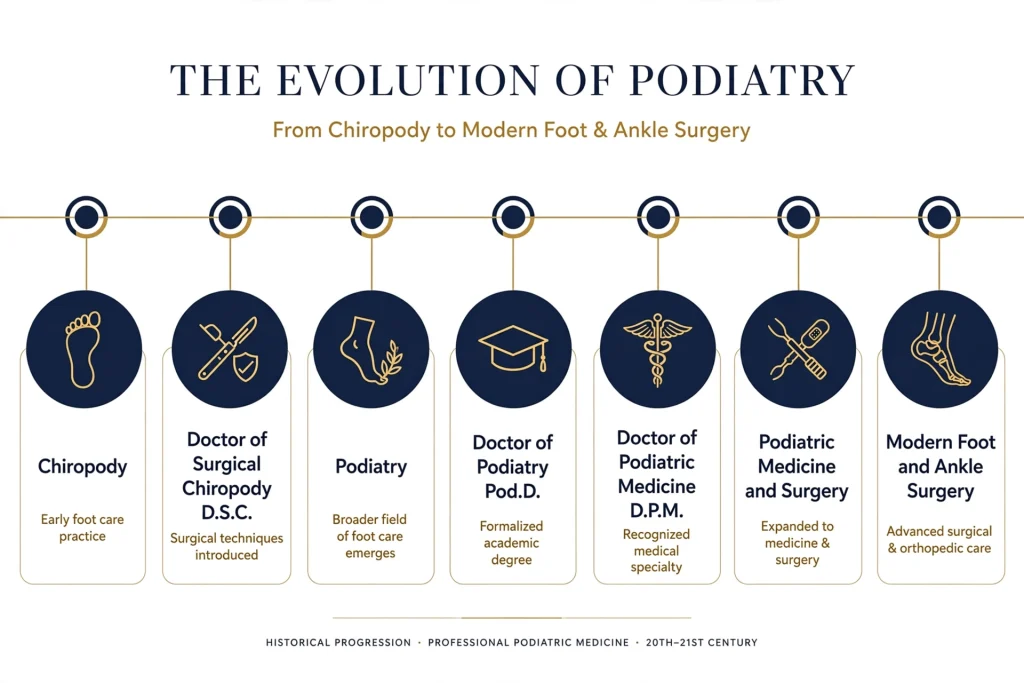
The profession evolved from chiropody to podiatry to podiatric medicine and surgery. American practitioners once earned the Doctor of Surgical Chiropody (D.S.C.) degree. In 1942, surgeons within the profession established the American College of Foot Surgeons, the organization that became today’s American College of Foot and Ankle Surgeons (ACFAS). ACFAS describes its own history as part of the transformation of chiropody into podiatry and ultimately foot and ankle surgery.
Today, podiatric physicians complete four years of podiatric medical school followed by at least three years of postgraduate podiatric medicine and surgery residency. Foot and ankle surgeons who pursue surgical board certification undergo additional rigorous examination and case-review requirements through the American Board of Foot and Ankle Surgery (ABFAS).
Understanding this history helps explain what modern podiatric medicine actually is—and why reducing the profession to routine nail care can cause patients to miss opportunities for earlier diagnosis and appropriate treatment.
A Brief Timeline of Podiatric Medicine and Surgery
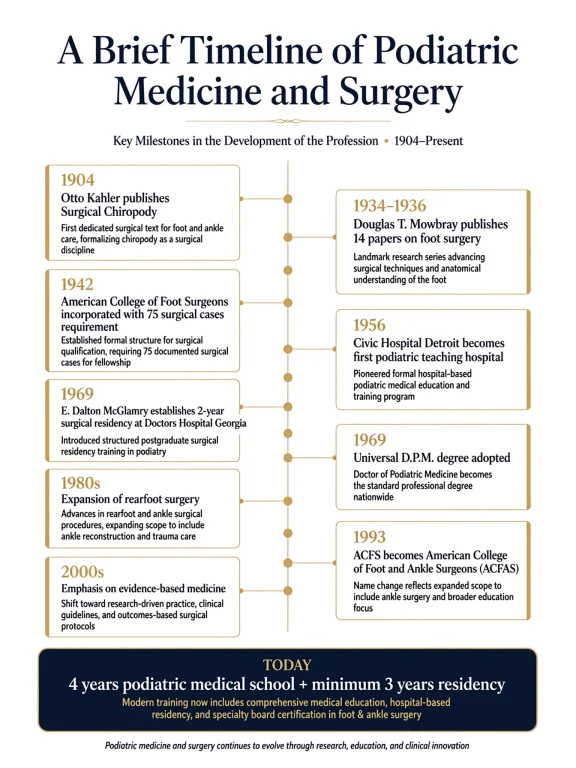
1904 — Otto Kahler publishes Surgical Chiropody for the Profession and Students.
1934–1936 — Douglas T. Mowbray begins publishing extensively on foot surgery; by 1936 he has published 14 papers.
1942 — American College of Foot Surgeons is incorporated.
1942 — Early Fellows are held to demanding written, oral, and surgical case requirements, including documentation of 75 surgical procedures.
1956 — Civic Hospital opens in Detroit as the first podiatric teaching hospital in the United States.
1969 — E. Dalton McGlamry establishes a two-year surgical residency at Doctors Hospital in Georgia; the program later expands to three years.
Late 1950s–1960s — The profession increasingly transitions from the term chiropody to podiatry.
1969 — Universal use of the D.P.M. degree is adopted within the profession.
1970s–1980s — Hospital-based residency programs and surgical education continue to expand.
1980s — Podiatric surgery increasingly encompasses rearfoot procedures.
1993 — The American College of Foot Surgeons becomes the American College of Foot and Ankle Surgeons, reflecting the expanding role of ankle surgery.
2000s — ACFAS increasingly emphasizes evidence-based medicine, research, and higher standards of postgraduate surgical education.
Today — Podiatric physicians complete four years of podiatric medical school followed by postgraduate residency training in podiatric medicine and surgery, with additional board certification and fellowship opportunities for those pursuing advanced specialization.
From Chiropody to Podiatry
The earliest American practitioners who treated foot problems were part of a very different healthcare environment from today’s podiatric physicians.
The terminology was chiropody, and practitioners were generally known as chiropodists. Over time, however, educational standards increased and the profession developed increasingly sophisticated approaches to the diagnosis and treatment of foot disorders.
One of the most revealing milestones is the Doctor of Surgical Chiropody (D.S.C.) degree. In 1914, the first Doctor of Surgical Chiropody was awarded.
The title itself is significant.
Surgical was part of the doctoral degree.
The profession was therefore not simply defining itself around routine foot care. Surgical treatment was becoming part of the professional identity of American chiropody even before the modern terminology of podiatric medicine was established.
The terminology subsequently evolved through degrees such as the Doctor of Podiatry (Pod.D.), which was first issued in 1939, and ultimately the Doctor of Podiatric Medicine (D.P.M.).
From D.S.C. to D.P.M.
The transition in degree titles occurred alongside the profession’s broader transformation.
According to the historical record of ACFAS, early foot surgeons commonly earned the Doctor of Surgical Chiropody (D.S.C.) degree, while some held the Doctor of Podiatry (Pod.D.) degree. The profession gradually moved from chiropody to podiatry during the late 1950s and 1960s, and the D.P.M. degree became the universal degree designation used by the profession by 1969.
The change in terminology reflected more than a new name. It occurred during decades of expanding medical education, hospital training, surgical specialization, residency development, and professional organization.
In other words, D.S.C. → Pod.D. → D.P.M. was part of the profession’s evolution—not a change from a non-medical occupation into medicine overnight.
The change was more than a change in wording. It occurred alongside increasing educational requirements, professional organization, medical integration, surgical development, and expanding clinical responsibilities.
Surgery Was Already Part of the Professional Evolution
The history is more nuanced than simply saying that early chiropodists were “nail cutters” who later became surgeons.
Early state laws did restrict chiropodists’ surgical authority, and much early surgery was indeed concentrated on ingrown nails, corns, and similar conditions. But individual practitioners were already pushing the boundaries of foot surgery decades before the modern D.P.M. existed.
Otto Kahler published Surgical Chiropody for the Profession and Students in 1904. Reuben Gross demonstrated ingrown-nail surgery in the 1920s. Ralph Fowler developed a surgical procedure involving resection of the proximal phalanx in 1934. Douglas T. Mowbray, who later became the first president of the American College of Foot Surgeons, began publishing extensively on foot surgery in the 1930s.
By 1936, Mowbray had published 14 papers on foot surgery, establishing an important body of surgical literature for the developing specialty.
The profession’s challenge was therefore not simply learning how to perform surgery. It was developing standards, training, hospital access, credentialing, and legal recognition that would allow appropriately trained practitioners to practice surgery consistently and safely.
1942: The Formation of Organized Podiatric Surgery
One of the most important dates in the history of American podiatric surgery is 1942.
On March 23, 1942, the organization that became ACFAS was incorporated as the American College of Foot Surgeons (ACFS). The historical record describes the founders’ goal of creating an organization dedicated to advancing foot surgery and establishing professional standards.
Today, ACFAS is a professional society representing thousands of foot and ankle surgeons and is dedicated to advancing the art and science of foot, ankle, and related lower-extremity surgery.
The significance of 1942 is easy to miss.
Organized American podiatric surgery was being developed more than 80 years ago.
This was not the beginning of a profession that later discovered surgery. It was part of a continuing effort within the profession to develop formal surgical standards, education, credentialing, and recognition for physicians specializing in the foot.
ACFAS itself describes its first 75 years as a transformation of “chiropody to podiatry to foot and ankle surgery.”
The Problem Was Professional Competency and Hospital Access
The founders of the American College of Foot Surgeons were confronting a problem that remains relevant to specialty medicine today: how should a profession demonstrate that its specialists are competent to perform surgery?
William J. Stickel, executive secretary of the National Association of Chiropodists, identified the need for a measurable standard of competency for obtaining hospital privileges. Douglas T. Mowbray and his colleagues developed a qualifying organization modeled in part on standards used by the American College of Surgeons.
The requirements were demanding for the era. Candidates for associate membership underwent written and oral examinations. Fellowship required submission of case records documenting 75 surgical procedures, including substantial representation of both soft-tissue and bone surgery, with detailed documentation required for many of the cases.
The purpose was not simply to create a professional club. The founders explicitly sought to establish surgical standards, teach standardized techniques, develop new techniques, and protect both the public and the profession.
On March 23, 1942, the organization was incorporated as the American College of Foot Surgeons.
The significance is important: organized American podiatric surgery was developing formal surgical competency standards more than eight decades ago.
Building Hospitals to Train Podiatric Surgeons
The development of podiatric surgery required more than surgical techniques. It required hospitals, operating rooms, postgraduate education, and supervised training.
A major milestone occurred on June 4, 1956, when Earl Kaplan opened Civic Hospital in Detroit, described in the ACFAS historical record as the first podiatric teaching hospital in the United States.
Civic Hospital provided a setting for postgraduate surgical education, including training in surgical technique, asepsis, hospital protocols, laboratory and radiographic procedures, instrumentation, and perioperative care.
The program soon expanded into residency training. Trainees progressed from basic surgical participation to increasingly advanced operative experience under supervision.
Civic Hospital became an important model for the development of subsequent podiatric surgical residency programs around the country.
This represented a fundamental change in the profession:
Foot surgery was moving from individual practitioners learning techniques to organized postgraduate surgical education.
Education, Competency, and Legal Scope Were Not the Same Thing
The history also demonstrates an important distinction that remains relevant today: training, professional competency, hospital privileges, and legal scope of practice are separate issues.
In the late 1940s, only a limited number of states permitted extensive surgical practice by chiropodists. Some practitioners received surgical training in hospitals but were still restricted by state law from performing procedures they were trained to perform or from exercising privileges such as admitting patients or signing hospital charts.
The profession therefore spent decades working on several fronts simultaneously:
- Improving education
- Developing residency training
- Establishing surgical competency standards
- Obtaining hospital privileges
- Expanding legal scope of practice
- Developing professional certification
- Establishing recognition within the broader healthcare system
The modern podiatric physician emerged from the combination of these developments—not from a single change in degree title.
The Evolution Was Educational as Well as Surgical
The professional identity of podiatry changed as its educational requirements changed.
The modern DPM pathway is substantially different from the historical training of early chiropodists.
One of the most important developments was the emergence of longer, hospital-based surgical residencies.
In 1969, E. Dalton McGlamry established the Section on Podiatric Surgery at Doctors Hospital in Tucker, Georgia. The program initially provided two years of training and was expanded to three years in the early 1970s.
Programs such as McGlamry’s, along with developing residency programs in California and elsewhere, helped establish the model of prolonged postgraduate surgical education that ultimately became the foundation of modern podiatric surgical training.
Today, a Doctor of Podiatric Medicine completes:
- Four years of podiatric medical school
- Basic and clinical sciences
- General medical education
- Pharmacology
- Pathology
- Surgery
- Medical imaging
- Foot and ankle-specific diagnosis and treatment
- Postgraduate podiatric medicine and surgery residency
ACFAS notes that the four-year podiatric medical curriculum is comparable in length to allopathic and osteopathic medical school, while providing intensive foot and ankle education beginning in the first year.
Following medical school, contemporary podiatric medicine and surgery residency programs require a minimum of three years of postgraduate training. Residency includes both podiatric and non-podiatric medical and surgical disciplines, with substantial additional training in foot, rearfoot, and ankle surgery.
For physicians who pursue surgical board certification, the training continues beyond the DPM and residency.
ABFAS certification involves a comprehensive process that includes examination, surgical competency assessment, and case review.
This distinction matters
A podiatrist is not defined by the procedure most commonly associated with the profession.
A podiatric physician’s education is directed toward the diagnosis and treatment of diseases, deformities, injuries, and other disorders of the foot and ankle.
The procedure may be nail care.
The procedure may be an orthotic prescription.
The procedure may be wound care.
The procedure may be an injection.
The procedure may be surgery.
The procedure does not define the physician.
From Forefoot Surgery to Foot and Ankle Surgery
The expansion of podiatric surgery did not stop with the forefoot.
Podiatric surgery initially developed largely around forefoot procedures. By the 1980s, however, surgical practice had increasingly expanded into the rearfoot. By the early 1990s, podiatric surgical residency programs routinely included ankle surgery.
The profession’s own surgical literature reflected this change. By the early 1990s, approximately 40% of articles in the Journal of Foot Surgery addressed rearfoot and ankle surgery.
The professional organization eventually changed its name to reflect the evolution in clinical practice.
In 1992, members voted overwhelmingly in favor of changing the name from the American College of Foot Surgeons to the American College of Foot and Ankle Surgeons (ACFAS), effective January 1, 1993.
The name change was more than cosmetic.
It acknowledged that the scope of contemporary podiatric surgery had expanded from its historical emphasis on the forefoot to comprehensive foot and ankle surgical practice.
The Problem With Viewing Podiatry Too Narrowly
When podiatry is viewed primarily as routine foot care, a form of fragmentation can occur.
A patient with heel pain may be referred directly to physical therapy.
A patient with a suspected stress fracture may be sent elsewhere for imaging.
A patient with recurrent sports injuries may receive treatment for each episode without evaluation of the underlying biomechanics.
A patient with a painful deformity may simply live with it.
A patient with diabetes may enter the podiatric system only after developing an ulcer.
Each of these pathways may be appropriate in an individual case.
The problem occurs when podiatry is not considered early enough to help determine the appropriate pathway.
Historically, one of the profession’s central challenges was gaining recognition for appropriately trained foot surgeons so they could participate fully in the care of their patients. Today, the challenge may be different: ensuring that the foot and ankle specialist is considered early enough in an increasingly fragmented healthcare system.
A podiatric physician can evaluate the foot and ankle problem, establish or refine the diagnosis, initiate conservative treatment, determine whether additional testing is necessary, and identify when another specialist should become involved.
Why Does the Scope of Podiatric Practice Matter?
It means evaluation by a physician whose practice is focused on the foot and ankle.
That distinction can help reduce unnecessary fragmentation of care.
What Does a Modern Podiatric Physician Evaluate?
Comprehensive podiatric medicine encompasses a broad range of conditions, including:
- Heel pain and plantar fasciitis
- Stress fractures
- Sports injuries
- Tendon disorders
- Achilles tendon disorders
- Peroneal tendon disorders
- Forefoot pain
- Neuromas
- Sesamoid disorders
- Bunions
- Hammertoes
- Arthritis
- Foot deformity
- Biomechanical disorders
- Gait abnormalities
- Diabetic foot complications
- Peripheral neuropathy affecting the feet
- Peripheral arterial disease affecting the feet
- Wounds and ulcers
- Charcot neuroarthropathy
- Recurrent pressure areas
- Limb-threatening foot conditions
- Conditions requiring reconstructive or corrective surgery
Individual podiatrists develop different areas of expertise, so patients and referring providers should consider the physician’s training and practice focus when selecting a specialist.
Conservative Treatment Is Part of Surgical Practice
Another misconception is that referral to a foot and ankle surgeon means that surgery is inevitable.
It does not.
A surgical specialist must first determine whether surgery is appropriate at all.
Depending on the diagnosis, treatment may include:
- Activity modification
- Footwear modification
- Over-the-counter or custom orthotics
- Bracing
- Physical therapy
- Stretching and strengthening
- Medication
- Injection therapy
- Extracorporeal shockwave therapy
- Offloading
- Wound care
- Preventive care
- Observation and follow-up
Surgery may be considered when conservative treatment has failed, when structural correction is appropriate, or when the condition requires operative management.
The goal is not to perform surgery. The goal is to determine what the patient needs.
At-Risk Foot Care Is Medical Care
Routine foot care has an important place within podiatric medicine.
For patients with diabetes, peripheral neuropathy, peripheral arterial disease, previous ulceration, amputation history, or other risk factors, regular podiatric assessment can help identify problems before they become more serious.
A comprehensive visit may involve evaluation of:
- Circulation
- Protective sensation
- Skin integrity
- Pressure areas
- Deformity
- Footwear
- Gait and biomechanics
- Risk for ulceration
- Early tissue breakdown
- Signs of infection
The procedure performed during the visit is only one component of the encounter.
The medical assessment is equally important.
From Doctor of Surgical Chiropody to Doctor of Podiatric Medicine
The history of ACFAS provides another window into the profession’s transformation.
Early practitioners faced a healthcare environment in which foot care was often viewed as a peripheral service rather than a medical specialty. As surgical techniques developed, practitioners within the profession sought greater educational rigor, surgical standards, hospital access, and professional recognition.
The founding of the American College of Foot Surgeons in 1942 was an important step in that process.
Over subsequent decades, the profession continued to develop:
Chiropody
↓
Doctor of Surgical Chiropody
↓
Podiatry
↓
Doctor of Podiatry
↓
Doctor of Podiatric Medicine
↓
Podiatric Medicine and Surgery
↓
Modern Foot and Ankle Surgery
This was not simply a series of name changes.
It was a progression in education, training, specialization, surgical standards, and clinical responsibility.
Modern Podiatric Surgery
Contemporary podiatric foot and ankle surgery encompasses a wide range of procedures, although the exact scope of practice varies by physician, training, board certification, and state law.
Depending on the surgeon’s training and practice focus, modern foot and ankle surgery may include:
Forefoot and Deformity Surgery
- Bunion correction
- Hammertoe correction
- Metatarsal procedures
- Revision surgery
- Forefoot reconstruction
Trauma
- Fracture management
- Dislocation treatment
- Tendon injuries
- Soft-tissue injuries
Rearfoot and Ankle Surgery
For appropriately trained surgeons, this may include:
- Reconstructive rearfoot and ankle surgery
- Ankle arthroscopy
- Complex deformity reconstruction
- Total ankle replacement
Diabetic Limb Preservation
Podiatric surgeons may also participate in multidisciplinary limb-preservation care involving:
- Wound management
- Infection management
- Offloading
- Surgical debridement
- Amputation prevention
- Partial foot amputation when necessary
- Coordination with vascular and medical specialists
The appropriate treatment depends on the individual patient’s condition and the surgeon’s specific training.
From Surgical Case Reports to Evidence-Based Medicine
Professional maturation also occurred in the way podiatric surgery evaluated and communicated medical knowledge.
In the early decades of ACFAS, surgical case reports were an important part of professional education and even played a role in surgical credentialing. As medical research standards evolved, however, the profession increasingly adopted evidence-based medicine.
By the early 2000s, ACFAS recognized that foot and ankle surgery needed to move beyond reliance on individual case experiences and toward research incorporating stronger study design, statistical analysis, peer review, and clearly defined levels of evidence.
The Journal of Foot & Ankle Surgery subsequently embraced this transition.
This evolution is another important part of the history of podiatric medicine: the profession did not simply expand what its surgeons could do. It also continued to raise the standards by which surgical knowledge and outcomes were evaluated.
Podiatry and the Fragmentation of Foot and Ankle Care
The modern healthcare system divides patients among many specialties.
That division can be appropriate.
But the foot and ankle do not exist as separate pieces of anatomy simply because healthcare is organized into separate departments.
A patient may have:
Pain → physical therapy
Fracture → orthopedics
Ulcer → wound care
Circulation problem → vascular surgery
Diabetes → endocrinology
Nerve symptoms → neurology
Skin lesion → dermatology
Each specialist may appropriately address one part of the problem.
But sometimes what is missing is a physician who looks at the foot and ankle as a whole.
This is where early podiatric evaluation can help.
A podiatric physician can identify the problem that falls within podiatric expertise and coordinate with other specialists when it does not.
The goal is not to keep every problem in podiatry.
The goal is to identify the right diagnosis, involve the right expertise, and establish the right treatment plan as early as possible.
When Should a Patient Be Referred?
Consider podiatric evaluation when a patient has:
- Persistent or recurrent foot or ankle pain
- An unclear diagnosis
- Symptoms that have not responded to initial treatment
- A suspected stress fracture
- Sports-related foot or ankle problems
- Tendon disorders
- Plantar heel pain
- Forefoot pain
- Progressive deformity
- Biomechanical or gait problems
- Diabetic foot concerns
- Peripheral neuropathy affecting the foot
- Peripheral arterial disease affecting the foot
- A wound or ulcer
- Recurrent pressure areas
- Charcot neuroarthropathy
- A condition potentially requiring surgery
- A foot or ankle problem for which the appropriate referral destination is uncertain
Referral does not commit the patient to surgery.
It provides an opportunity for focused evaluation by a physician specializing in the foot and ankle.
Why Early Podiatric Evaluation Can Prevent Fragmentation
A patient does not necessarily need to move through multiple specialists before reaching podiatry.
In many cases, the podiatrist can serve as an early point of specialty evaluation.
The podiatric physician may determine that:
- Conservative treatment is appropriate
- Physical therapy is indicated
- Orthotics or footwear modification may help
- Imaging is needed
- Vascular evaluation is necessary
- Wound care is appropriate
- Another medical specialist should become involved
- Surgery should be considered
- No further intervention is necessary
This approach can help turn a series of disconnected referrals into a coordinated treatment pathway.
Comprehensive Foot and Ankle Care in Seattle
At Seattle Foot and Ankle Center, Dr. J. John Hoy provides office-based comprehensive foot and ankle medical and surgical care.
The practice emphasizes:
- Accurate diagnosis
- Conservative treatment whenever appropriate
- Biomechanics and deformity
- Sports medicine
- Diabetic foot and limb preservation
- Wound management
- Forefoot reconstruction
- Revision forefoot surgery
- Appropriate surgical treatment
The goal is not to perform more procedures.
The goal is to understand the problem, determine the appropriate treatment, and intervene when intervention is medically indicated.
For referring providers, this means a patient does not have to arrive with a predetermined diagnosis or a predetermined treatment.
A patient can simply arrive with a foot or ankle problem that needs a specialist’s evaluation.
The Evolution Continues
The evolution from Doctor of Surgical Chiropody to Doctor of Podiatric Medicine represents more than a change in professional terminology.
It reflects decades of increasing education, specialization, surgical development, professional organization, residency training, certification, and clinical experience.
The history of ACFAS is part of that story. Founded in 1942 as the American College of Foot Surgeons, the organization has spent more than eight decades advancing foot and ankle surgery. Today, ACFAS represents a large community of foot and ankle surgeons whose members are DPMs who have completed podiatric medical school and surgical residency training.
The modern podiatric physician is therefore not defined by the most familiar procedure associated with the profession.
The common denominator is not nail care.
The common denominator is foot and ankle medicine and surgery.
For patients and referring providers, recognizing that distinction can make a meaningful difference.
The Goal Is Better Patient Care
The goal of comprehensive podiatric care is not to replace other healthcare professionals or to perform surgery whenever possible.
It is to ensure that patients with foot and ankle problems receive timely evaluation by a physician whose practice is focused on these conditions.
Sometimes the answer is reassurance.
Sometimes it is conservative treatment.
Sometimes it is preventive care or wound management.
Sometimes collaboration with another specialist is appropriate.
Sometimes surgery is the right answer.
The goal is not to keep every foot and ankle problem within podiatry. The goal is to identify the right diagnosis, involve the right expertise, and establish the right treatment plan as early as possible.
Refer a Patient for Comprehensive Foot and Ankle Evaluation
If you are a primary care physician, family medicine physician, internist, endocrinologist, physical therapist, wound-care professional, vascular specialist, sports medicine provider, or other healthcare professional and have a patient with a foot or ankle problem that would benefit from focused evaluation, consider referral to a podiatric physician.
The question does not have to be:
“Does this patient need surgery?”
It can simply be:
“Would a foot and ankle physician help establish the diagnosis and treatment plan?”
If the answer may be yes, an evaluation can provide the additional clinical perspective needed to determine the next step.
Seattle Foot and Ankle Center provides comprehensive office-based foot and ankle medical and surgical evaluation in Seattle.
Dr. J. John Hoy is a Fellow of the American College of Foot and Ankle Surgeons and a Fellow of the Faculty of Podiatric Medicine of the Royal College of Physicians and Surgeons of Glasgow. This history is documented in The Evolution of a Profession: The First 75 Years of the American College of Foot and Ankle Surgeons, 1942–2017, by historian Kenneth Durr, PhD, with Jerome S. Noll, DPM, EdD, FACFAS.
In pain? Don’t wait. Early treatment leads to faster recovery. Urgent appointments available. Read about Conditions We Treat. Request an Appointment online. Call: 206-682-8741 or Contact Us. If you like our content, please link it to your website and Collaborate With Us. Thank you.