
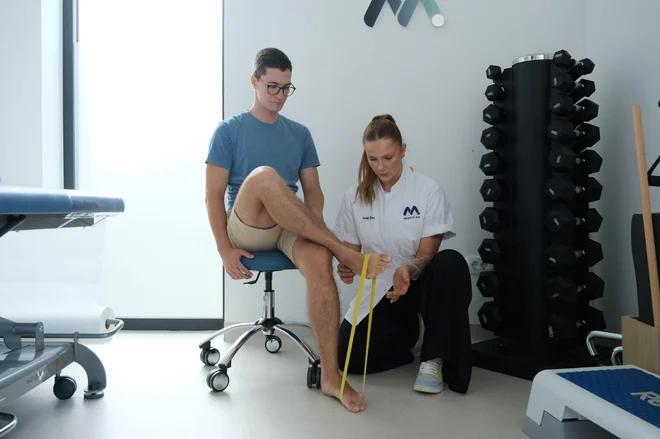
Foot and ankle rehabilitation is not simply a matter of being given a list of exercises and told to “strengthen your feet.”
Foot and ankle rehabilitation is the structured use of movement, strengthening, mobility, balance, and progressive loading to restore function after injury or for painful conditions. At Seattle Foot and Ankle Center, Dr. J. John Hoy incorporates rehabilitation into treatment plans, emphasizing that a precise diagnosis must precede any exercises, as different conditions require tailored approaches. The objective of rehabilitation is to gradually increase the body's ability to tolerate activity, addressing the relationship between load and tissue capacity when demands exceed current limits.
When foot or ankle pain persists, the first step is understanding why it is happening. Once the diagnosis and contributing factors are understood, exercise may become an important part of medical treatment—helping restore strength, improve movement, build tissue capacity, and reduce the likelihood of recurring problems.
At Seattle Foot and Ankle Center, Dr. J. John Hoy incorporates rehabilitation and progressive exercise into appropriate foot and ankle treatment plans. Depending on the condition, rehabilitation may be used alongside conservative treatments such as shockwave therapy, orthotics, footwear modification, activity modification, or other medical care.
The goal is not simply to exercise the foot. The goal is to treat the problem.
What Is Foot and Ankle Rehabilitation?
Foot and ankle rehabilitation is the structured use of movement, strengthening, mobility, balance, and progressive loading to help restore function after injury or in response to a painful or mechanically stressed condition.
Rehabilitation may address:
- Foot and ankle strength
- Tendon capacity
- Joint mobility
- Balance and proprioception
- Gait and movement patterns
- Lower-extremity coordination
- Tolerance to standing, walking, running, or other activities
- Gradual return to sports and exercise
Importantly, rehabilitation does not begin with exercises simply because an exercise is popular.
Diagnosis comes first.
Different conditions require different approaches. An exercise that is appropriate for one tendon problem may be inappropriate for another. Someone with a bone stress injury, for example, requires a very different loading strategy from someone recovering from a tendon disorder.
Why Exercise Can Be Part of Medical Treatment
Many foot and ankle problems are influenced by the relationship between load and tissue capacity.
Walking, running, jumping, standing, and sports all place forces through the foot and ankle. When the demands placed on a tissue repeatedly exceed its current capacity, symptoms may develop or persist.
Treatment therefore may involve more than simply reducing activity.
The objective can be to gradually increase the body’s ability to tolerate the activity that matters to you.
A rehabilitation program may progressively move from relatively simple activities toward greater resistance, speed, balance, or impact as appropriate.
This can include progression from:
Isometric exercise → strengthening → eccentric or controlled loading → functional loading → higher-level activity
The exact progression depends on the diagnosis, symptoms, physical findings, and the patient’s goals.
Conditions That May Benefit From Foot and Ankle Rehabilitation
Exercise-based rehabilitation can be useful for a variety of foot and ankle conditions.
Plantar Fasciitis and Plantar Heel Pain
Plantar heel pain may involve more than inflammation or irritation of the plantar fascia. Treatment may include progressive loading of the plantar fascia and calf complex, strengthening, mobility work, footwear changes, orthotics, and other appropriate interventions.
For some patients, exercise becomes an important part of restoring tolerance to standing, walking, running, or other activities.
Achilles Tendon Problems
Achilles tendinopathy is often treated with progressive loading rather than prolonged rest alone.
A rehabilitation program can help gradually increase the capacity of the Achilles tendon and calf complex. The appropriate exercises and rate of progression depend on the location and severity of the problem and the patient’s activity requirements.
Ankle Instability
Repeated ankle sprains can sometimes leave patients feeling that an ankle is weak, unstable, or unreliable.
Rehabilitation may address:
- Strength
- Balance
- Proprioception
- Single-leg control
- Coordination
- Functional movement
The objective is to improve the ankle’s ability to respond to the demands placed upon it.
Tendon Disorders of the Foot and Ankle
Other tendons around the foot and ankle may also require progressive rehabilitation.
Treatment may involve strengthening the affected tendon while addressing contributing biomechanical and functional factors.
Metatarsalgia and Forefoot Pain
Forefoot pain is not one diagnosis.
Metatarsalgia can have multiple causes, including mechanical overload, footwear, altered gait, structural factors, and other conditions.
Once the underlying cause has been identified, rehabilitation may be incorporated to improve strength, movement, and tolerance to loading when appropriate.
Sports and Running Injuries
Runners and active patients often want more than simply being told to stop the activity that causes pain.
A rehabilitation approach can help establish what the foot or ankle can tolerate now and then progressively rebuild capacity for the demands of running, hills, jumping, or sport.
The goal is often a gradual return to activity, rather than an abrupt return once pain happens to disappear.
Rehabilitation Is Not the Same as “Just Go to Physical Therapy”
Physical therapy can be an important part of recovery, and referral to a physical therapist is sometimes appropriate.
But rehabilitation itself is not synonymous with physical therapy.
Exercise can be incorporated into a podiatric medical treatment plan just as it can be incorporated into treatment by other medical specialists.
The important question is:
What does this particular patient need?
Depending on the diagnosis, treatment may include physician-directed rehabilitation, physical therapy, shockwave therapy, orthotics, footwear changes, activity modification, medication, injections when appropriate, or surgery when necessary.
These approaches are not necessarily competing alternatives.
They can sometimes work together.
Rehabilitation Can Be Combined With Other Conservative Treatment
For many foot and ankle conditions, there is no single treatment that needs to do everything.
For example, a patient with a chronic tendon or plantar fascia problem may benefit from a combination of:
Diagnosis → exercise rehabilitation → appropriate loading → shockwave therapy → orthotic support → gradual return to activity
The combination depends on the individual patient.
At Seattle Foot and Ankle Center, shockwave therapy has been used since 2018 as part of conservative treatment for appropriate conditions. Rehabilitation and exercise may be incorporated when they address an important part of the patient’s problem.
The principle is simple:
Rehabilitation can be in addition to other treatment—not necessarily instead of it.
Why Progressive Loading Matters
One of the most important concepts in rehabilitation is that tissues adapt to appropriate loading.
Too little loading may leave a patient deconditioned.
Too much loading too quickly may aggravate symptoms.
The goal is to find an appropriate level of challenge and progressively increase it as the patient’s capacity improves.
This is particularly relevant for active patients who want to return to:
- Running
- Hiking
- Walking longer distances
- Gym workouts
- Tennis
- Golf
- Recreational sports
- Work requiring prolonged standing or walking
Rehabilitation therefore isn’t simply about making an exercise harder.
It is about making the patient more capable of doing what they need and want to do.
What About Balance and Proprioception?
Strength is only one component of foot and ankle function.
Balance and proprioception—the body’s ability to sense position and movement—can also be important.
This can be particularly relevant after ankle sprains or in patients who report recurrent instability.
Exercises may progress from stable, controlled positions to more challenging single-leg and functional activities as appropriate.
Again, the exercise is selected according to the problem being treated rather than simply because it is a standard “foot exercise.”
Rehabilitation Starts With the Right Diagnosis
Persistent foot and ankle pain should not automatically be treated as a need for more stretching or strengthening.
Pain in the same location can come from very different conditions.
For example, heel pain could involve the plantar fascia, nerve irritation, a stress injury, tendon pathology, or another cause. Similarly, ankle pain may arise from a tendon, ligament, joint, bone, nerve, or other structure.
If the diagnosis is wrong, the exercise program may be wrong as well.
That is why evaluation matters.
At Seattle Foot and Ankle Center, the approach begins with identifying the source of the problem and determining which treatment options make sense for that particular patient.
When Should You See a Foot and Ankle Physician?
Consider a medical evaluation when:
- Foot or ankle pain persists despite rest or self-treatment
- Pain repeatedly returns when you resume activity
- You are unsure what structure is causing the pain
- You have recurrent ankle sprains
- You have difficulty progressing your activity
- An exercise program has not solved the problem
- You want to return to running or sports after an injury
- You have swelling, weakness, instability, or difficulty bearing weight
- You have diabetes, neuropathy, poor circulation, or another condition that increases the risk of foot complications
A rehabilitation program is most useful when it is addressing the right problem.
Foot and Ankle Rehabilitation in Seattle
Foot and ankle rehabilitation is an important part of modern conservative podiatric care.
It does not mean replacing medical diagnosis with exercise.
It means recognizing that, for many patients, exercise itself can be part of the medical treatment plan.
Dr. J. John Hoy takes a diagnosis-first approach to foot and ankle care at Seattle Foot and Ankle Center. Treatment may include conservative care such as rehabilitation, progressive exercise, shockwave therapy, orthotics, and activity modification, with surgery considered when necessary.
The appropriate treatment depends on the diagnosis, the individual patient, and the demands they want to return to.
Conservative first. Surgical when needed.
If you have persistent foot or ankle pain and want to understand whether rehabilitation could be part of your treatment, schedule an evaluation with Dr. Hoy at Seattle Foot and Ankle Center.
Frequently Asked Questions
No. Physical therapy is one way rehabilitation may be delivered. Exercise and rehabilitation can also be incorporated into a physician-directed podiatric treatment plan when appropriate.
It can if the exercise, intensity, volume, or progression is inappropriate for the condition. Rehabilitation should be matched to the diagnosis and progressed according to the patient’s symptoms and capacity.
Not necessarily. Some patients may benefit from physical therapy, while others may receive physician-directed exercises as part of their podiatric treatment. The appropriate approach depends on the diagnosis and treatment goals.
Yes. For appropriate conditions, exercise rehabilitation and shockwave therapy can be complementary components of conservative treatment. Neither is automatically appropriate for every patient.
It can be an important component of returning to running when the underlying condition permits it. Rehabilitation can progressively address strength, loading capacity, balance, and tolerance to running-specific demands.
Because foot and ankle pain has many possible causes. Treatment that is appropriate for one condition may not be appropriate for another. Identifying the underlying problem helps determine what type of loading or exercise is appropriate.
Take the Next Step
If your foot or ankle pain keeps returning every time you resume normal activity, the answer may not be simply to rest longer—or to exercise more.
The first step is understanding what is causing the problem.
Once the diagnosis is clear, rehabilitation can become a targeted part of medical treatment designed around your foot, your activities, and your goals.
Seattle Foot and Ankle Center
Dr. J. John Hoy, Physician and Surgeon of the Foot and Ankle
Downtown Seattle
In pain? Don’t wait. Early treatment leads to faster recovery. Urgent appointments available. Read about Conditions We Treat. Request an Appointment online. Call: 206-682-8741 or Contact Us. If you like our content, please link it to your website and Collaborate With Us. Thank you.